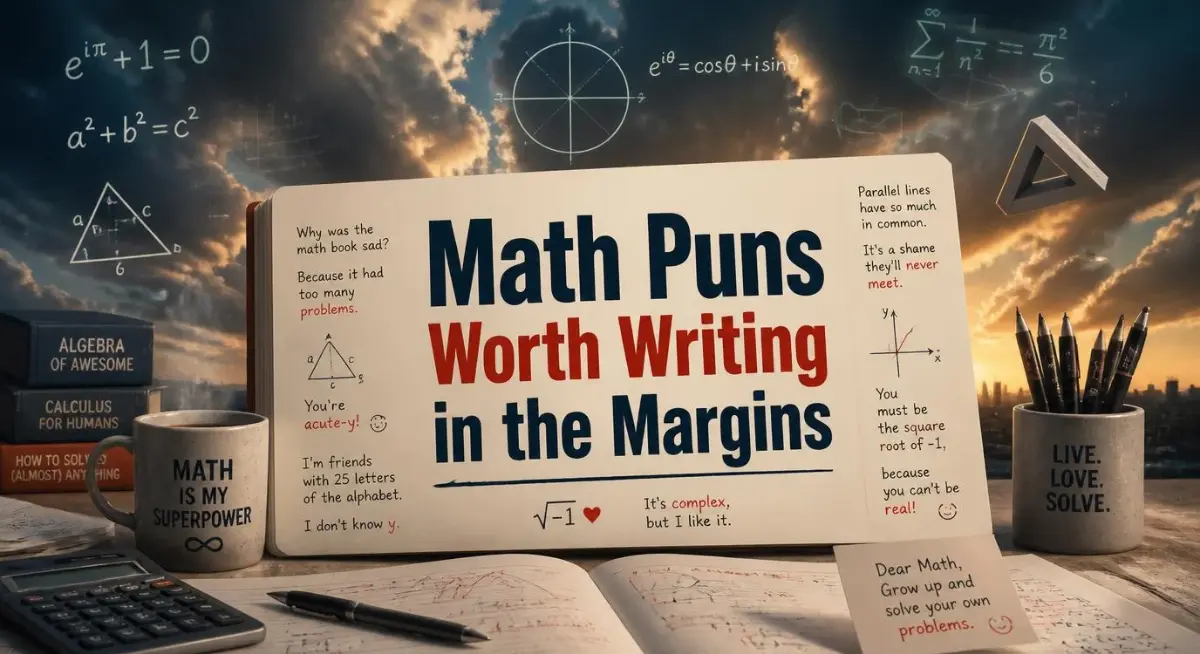
Math is full of words that already mean two things. Sum, odd, root, product, function, point, line and plane all show up in ordinary speech, which is why math puns are so easy to write and so hard to resist. A good one takes a second to read, gets a groan, and then gets copied into somebody’s notebook.
This collection has 150 clean math puns sorted by topic, so you can find the right one fast. Some are made for classrooms and homework, some for cards and captions, and some are just there to be said at the dinner table. You don’t need a degree to enjoy them, since each section starts with a short note on the idea behind the puns. Near the end you’ll find a method for writing your own, tips on using them, and a set of FAQs.
Everyday Math One-Liners
Start here if you want something short. These work in a text, on a sticky note or on the corner of a whiteboard, and none of them need any setup.
- Math puns are no problem, they just add up.
- I tried to write a math pun, but it didn’t add up.
- Don’t be so negative, add a positive.
- Let’s get to the point, as the line said.
- Life’s too short for bad math, or for long division.
- You can count on me, I’m good with numbers.
- I’m feeling a little irrational today, like pi.
- That joke was a real equalizer: everyone got it.
- You can always divide and conquer the day.
- Good friends are like good math: they always make sense.
Number Puns
Numbers have personalities in jokes: odd ones feel left out, primes feel special, and zero never has to prove anything. These work well on a poster or a flashcard.
- Why are odd numbers so lonely? They never have a pair.
- Why did the prime number feel special? Nobody could divide it up.
- A negative number walked into a room and said, I’m feeling down today.
- Why don’t numbers ever argue? They always agree on the sum.
- Why was the even number so calm? It was well balanced.
- Zero said it had nothing to prove, and it was right.
- Why was the number four so steady? It was a perfect square.
- Why did the digit go to therapy? It had issues with its place value.
- Why did the number cross the line? To get to the other side of the decimal.
- Why did the big number feel confident? It was always greater than the rest.
Algebra Puns
Algebra is the part of math where letters take over, and the jokes lean on variables, equations and the hunt for x. These suit a quiz warm-up or a note on a worksheet.
- I’d tell you an algebra joke, but I couldn’t find the right variable.
- Why was x always so mysterious? Because nobody could find it.
- Why did the equation get promoted? It had solved every problem.
- Algebra is just a lot of letters trying to figure out how they feel.
- Why did the variable go to the party? It wanted to be part of the equation.
- Why did the student bring a ladder to algebra? To reach the exponent.
- Why did the function feel so supported? It always had an input.
- A good equation is balanced, just like a good lunch.
- Why was the equation so honest? It always came out equal.
- I was going to say something clever, but I haven’t solved for x yet.
Geometry Puns
Geometry gives you shapes, angles and lines to joke about. These are easy to draw, so they work well on a classroom board or a worksheet.
- Why was the triangle so confident? It knew all its angles.
- Why did the circle get invited everywhere? It was well rounded.
- Why was the square always on time? It had all its sides in order.
- Why did the line end up at the party? It was a point of interest.
- Why did the right angle feel so proud? It always met the standard.
- What do you call a shape that tells jokes? A punny polygon.
- Why did the hexagon get a promotion? It saw every problem from six sides.
- Why did the compass get a gold star? It always pointed in the right direction.
- Why did the ruler win the contest? It measured up.
- Why did the cube feel balanced? All of its sides agreed.
Fraction and Decimal Puns
Fractions are a favorite target because they feel awkward to many students, and a joke helps. These fit a lesson on parts of a whole.
- Why was the fraction so nervous? It was always under pressure.
- Why was the fraction so humble? It always put the denominator first.
- Why did the decimal point stay calm? It always knew its place.
- Why did the half apply for a job? It wanted to be a whole employee.
- A fraction walked into a room and said, I’m feeling a bit divided.
- Why did the mixed number go to the party? It wanted to mingle.
- I’d say it’s a half-baked idea, but at least it’s half.
- Why did the decimal get lost? It was a point without a place.
- Why did the numerator feel important? It was always on top of things.
- Why was the pizza good at fractions? It always came in slices.
Calculus and Limits Puns
Calculus puns tend to be a little nerdy, with words like derivative, integral and limit. They work best with people who have taken the class and lived to tell about it.
- I’d tell you a calculus joke, but it’s derivative.
- Integrals know how to add things up.
- Why did the curve go to the doctor? It had a bad slope.
- Limits never quite get there, but they get close.
- Why did the asymptote feel sad? It could never quite reach the line.
- I’m not just a derivative, I’m an original function.
- Why do calculus students love slopes? They like taking things to the limit.
- Why did the derivative say it was in a hurry? It was always changing.
- Why was the integral so good at team projects? It knew how to add everyone’s contribution.
- The function said, I’ll take it from here, and the derivative nodded.
Statistics and Probability Puns
Statistics puns work because everyone has seen a number used to prove a point. These fit a data class, a report or a conversation about odds.
- Statistics show that 73 percent of statistics are made up.
- The odds of getting this pun right were pretty good.
- Why did the data go to the party? It wanted to be part of the mean crowd.
- Why is the mean always so average? It likes to stay in the middle.
- Why did the median get promoted? It was right in the middle of everything.
- The mode said, I’m the most popular, and nobody argued.
- Why did the probability student carry a coin? To flip it on the situation.
- A graph walked into a room and said, I’m feeling a little skewed.
- The chances of a good pun are one in a million, but I’ll take my chances.
- Why did the outlier feel left out? It was always at the edge of the group.
Pi Puns
Pi is the most famous number in math, and it has its own fan base. These work on a banner, a cake or a post around March 14th.
- Pi is irrational, but I still love it.
- I’d tell you a pi joke, but it goes on forever.
- Pi never repeats itself, unlike my dad jokes.
- Why did the circle love pi? It never ran out of things to say.
- Why was pi so popular? It had endless charm.
- I wanted to bake a pie, but pi was too hard to measure.
- What do you get when you divide a pumpkin’s circumference by its diameter? Pumpkin pi.
- Let’s celebrate pi day with a slice of something delicious.
- The best things in life are irrational, like pi and my snack cravings.
- Don’t be a square, be a circle with pi.
Math Teacher and Classroom Puns
Teachers use puns because students remember them. These are friendly and simple, so they fit a bulletin board, a warm-up or a note on the door.
- My math teacher says I have potential, and I’ve been working on my power.
- Why did the math teacher bring a ladder? To reach the next level.
- Our math teacher is a-sum-ing we’re all paying attention.
- My teacher says I’m a real problem solver, and I’m working on my own issues.
- The math teacher said class was dismissed, and everyone divided by the door.
- Why did the math textbook look so stressed? It was full of unsolved issues.
- Our class is a perfect set: we all belong together.
- Why did the teacher write on the board? She had a lot on her mind.
- Math class is where good friends add up.
- Why did the teacher love the chalkboard? It always gave her a clean slate.
Homework and Test Puns
Homework and tests are where students feel math the most, and the jokes reflect that. These work on a study guide, a group chat or a note to a classmate.
- I’d study for the math test, but I already did, and it didn’t add up.
- Why did the student hand in blank paper? It was a zero-sum game.
- Homework is just a lot of problems waiting for a solution.
- Why did the student bring a calculator to the test? To check the answer, and the question.
- Math homework is like a puzzle: you need to find the missing piece.
- Study hard, and the answers will fall into place.
- A good study group is the sum of its parts.
- I studied all night, and the results were a real equation.
- Why did the pencil get an A? It always got to the point.
- Why did the eraser stay calm during the test? It had a way of fixing mistakes.
Dad Joke Style Math Puns
These are built for maximum eye rolling. Say them with a straight face and wait a second before the groan.
- I asked the calculator how it was feeling. It said, I’m all added up.
- My dad said math is like a pizza: you slice it up and share it.
- I told my son to be positive. He said, I’m trying, but I keep running into negatives.
- Why did my dad bring a calculator to dinner? He wanted to split the check evenly.
- My dad says he’s a math genius, but he can’t divide his time evenly.
- I’d say my dad is a square, but he’s actually well rounded.
- My dad’s math jokes are so bad, they have no solution.
- I told my dad I was bad at math. He said, don’t worry, it all adds up in the end.
- My dad’s favorite exercise is multiplication tables.
- I asked my dad to help with my homework. He said, let’s work it out together.
Math Jokes for Kids
Kids like puns with a clear picture in them. These are short and silly, which makes them easy to read aloud in class or tuck into a lunchbox.
- Why did the kid bring a ruler to bed? To see how long he slept.
- What’s a snake’s favorite subject? Adders.
- Why did the clock fail math? It couldn’t keep track of time.
- What did one calculator say to the other? You can count on me.
- Zero told one: with me beside you, you’re worth ten.
- Why did the number nine feel nervous? It was close to ten.
- Why was the pencil so good at math? It always got to the point.
- Why did the kid eat his math homework? He wanted to take it in.
- What do you call a happy number? A positive one.
- Why did the number seven stay home? It was feeling a little odd.
Math Love Puns
Math has a soft side too. These are cheesy on purpose and work in a card, a text or a note tucked into a lunch bag.
- You’re the sum of all my best days.
- I’m no good at fractions, but you’re my better half.
- Together, we’re greater than the sum of our parts.
- You’re the one variable I never want to change.
- We add up, and I’d marry the equation.
- You’re the answer I’ve been solving for.
- My love for you is exponential, and the base keeps growing.
- Love is a function, and you’re my input.
- You’re the ten to my five: twice as good.
- Our love is a perfect set: nothing missing.
Short Math Captions
Captions work best when they are very short. Keep these under six words and let the photo or the board do the work.
- Add it up.
- Solve for fun.
- Do the math, then do the puns.
- The answer is always snacks.
- Count me in.
- Subtract the stress, add the fun.
- Right on the line.
- Divide the work, multiply the joy.
- Everything adds up.
- Show your work, and your smile.
Coming Up With Your Own Math Puns
Writing a math pun takes a few minutes once you know the pattern. Start with a math word and look for the everyday meaning hiding inside it.
Here are some word groups to work from. Sum sounds like “some,” which gives you a-sum-ing. Odd means strange as well as not divisible by two. Root works as a plant part and a math operation. Product works as something you sell and something you multiply. Function works as a math rule and as a party. Point works in geometry and in conversation. Rational works as a math number and as a way of thinking. Divide and conquer, add insult to injury and take it to the limit all come from phrases that carry math inside them.
Try this method. First, pick one math word. Second, write down its everyday meanings. Third, build a short sentence that works with both meanings. Fourth, read it out loud. If it takes more than a few seconds to explain, shorten it or switch to a different word.
How to Use These Math Puns
A hundred and fifty puns is a lot to sort through, so here is where each type fits best.
Classrooms: use the teacher, homework and number sections as warm-ups, bulletin board headers or notes on the door.
Study groups: use the algebra, geometry and statistics sections as a quick break between problems.
Pi Day: use the pi section on banners, cakes and posts around March 14th.
Kids: use the kids’ section on a lunchbox note or a worksheet header.
Cards and texts: use the love section and the everyday one-liners, which read warmly without needing any math background.
Social posts: stick to the short captions, which are small enough to sit under a photo.
FAQs About Math Puns
What makes a math pun different from a regular pun?
A math pun leans on a word that has a math meaning and an everyday meaning, such as sum, odd, root or function. The listener hears the everyday meaning first, then catches the math one, and that gap is the joke.
Which math words work best for puns?
Words that show up in both math and daily life tend to work best, including sum, odd, root, product, function, point, line, rational and divide. Each one slips into familiar phrases with very little effort.
Do math puns help students remember what they learn?
Teachers often use them as a warm-up, since a funny sentence tends to stick. A pun won’t teach a concept on its own, but it can make a term easier to recall and make a lesson feel lighter.
Can I use math puns if I’m not a math person?
Yes. The everyday, love and caption sections need no math background at all, and the other sections explain the idea behind the joke in a sentence or two.
When is Pi Day, and why is it on that date?
Pi Day falls on March 14th. The date is written 3/14 in month and day order, and pi starts with 3.14, so the two line up. It is a popular day for pi puns, pie recipes and classroom activities.
What should I do if nobody gets my math pun?
Keep it short and explain it in one sentence, or switch to a simpler one. A pun that needs a long explanation usually works better as a caption in a math class than as a joke at a party.
Conclusion
You now have 150 math puns across numbers, algebra, geometry, fractions, calculus, statistics, pi, classroom jokes, homework, dad jokes, kids’ lines, love notes and captions. A handful of words (sum, odd, root, product and function) do most of the work, and the rest comes from knowing where you plan to use them.
Pick two or three that sound like you and use them this week, whether that’s on a whiteboard, a card or a note in a notebook margin. If you come up with a math pun of your own, share it in the comments, and pass this list along to someone who enjoys a good groan.

Ohad Lesely is a writer and curious storyteller with a passion for discovering interesting ideas and presenting them in an engaging, easy-to-understand way. At PunOwl, he explores jokes, clever puns, entertaining stories, and engaging topics designed to keep readers informed, entertained, and coming back for more.